We’d All Just Wanted A Better World
A few weeks ago, a curator friend mentioned that they were working through some open call submissions that carried strong pleads of ‘Do not perceive me.’ It seemed self-conflicting, considering the applicants were submitting to be shown. Yet they seemed uneasy at the idea of being perceived by another, and it made me wonder about the relationship between the maker and the observer, the artist and the audience. I realized how it would always be simultaneously perplexing and inspirational, stressful yet comforting, challenging and validating.
This brief interaction made me think deeper of Ann Resnick’s Tell Me What You Think of Me, a two-part project investigating the relationship between the supposed subject and the observer (Part I), followed by a reversal of position as the artist took the researcher’s role to gain deeper understandings of those who’d contributed their observation of her work (Part II).
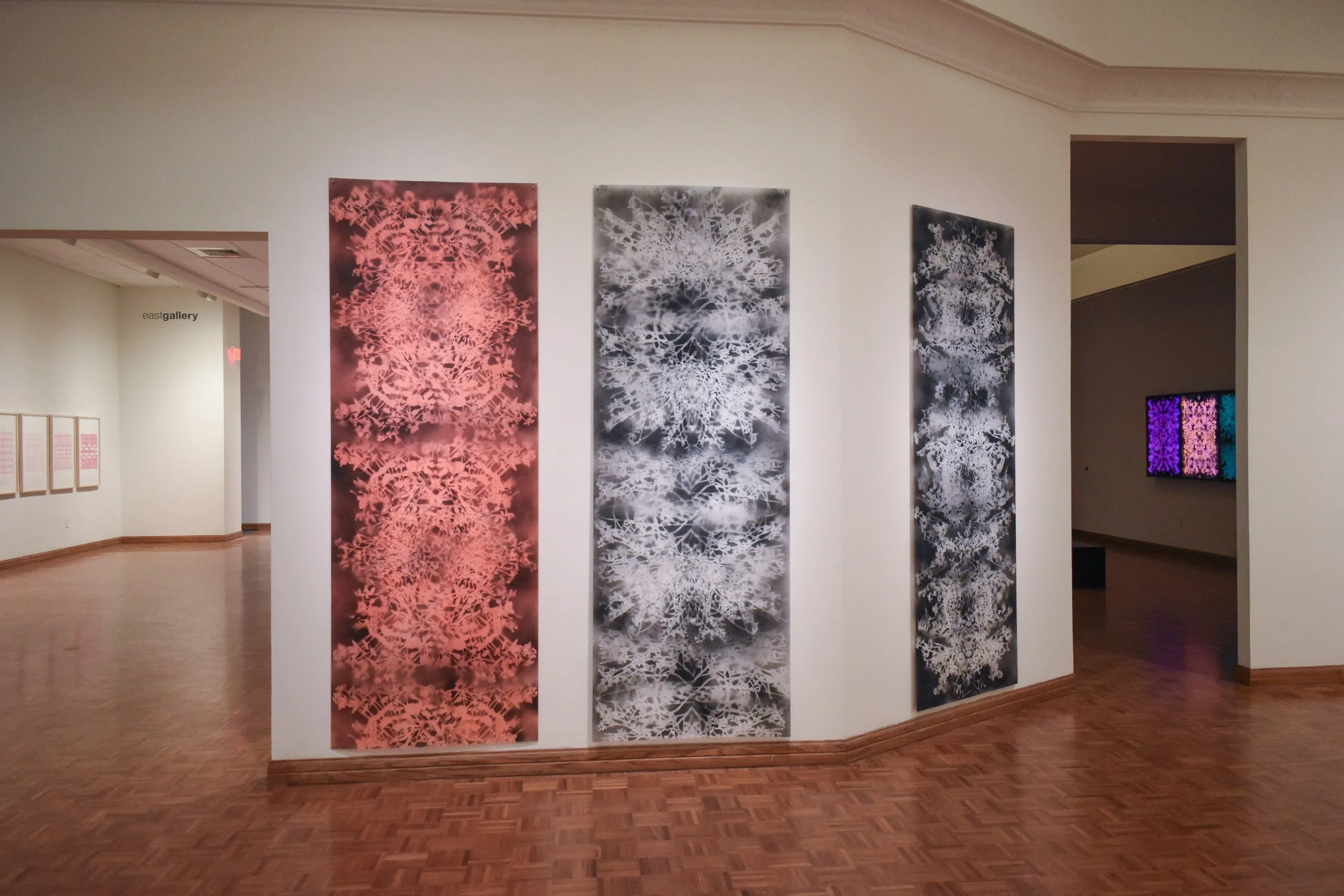
The first part of the exhibition debuted at Salina Art Center in 2024. Back then, Resnick presented a new body of work titled Something to Divine. The pieces in that exhibition resulted from meticulous labor as Resnick repurposed hand-drawn stencils she’d developed over the year that she would use to create large-scale, spray-painted images. Through careful positioning and patient repetition, Resnick crafted long, vertical scrolls where the same stencil was repeated to resemble infinity in complex patterns and designs similar to what one would see on a psychedelic trip.
While the pieces themselves did not carry specific meanings or divine prophecies, the audience inevitably made attempts to make sense of what was on the walls. The more one looked at the banners, the more they may try to identify patterns or decipher hidden meanings (as we often do in an art gallery). Indeed, a closer observation may reveal botanical or geometrical shapes rotated, mirrored, or rippled, or re-arranged.
To gain a deeper understanding of her audience, Resnick created a personality survey, which received responses from 46 participants during the first exhibition. The survey asked an array of questions like the participants’ favorite plants, animals, and birds. In doing so, Resnick turned the table and stepped into the observer’s role, as if she’d elevated herself from her original dimension. Entertain me in picturing a system of infinite containment. The first plane was the Resnick and her work, viewed by those coming to the gallery. The second plane was the exhibition visitors (specifically, survey participants), who've now become the subject of Resnick’s investigation. Now, we arrive at the third plane, taking place in the form of the latest iteration of Tell Me What You Think of Me, currently on view at Salina Arts Center through May 2nd. This time, the audience perceives not only the art on the wall, but also glimpses of the psyche of the exhibition goers before them.
It only makes sense, then, how the second exhibition also includes some of the pieces from the first exhibition in 2024, connecting time, space, and opinions over the span of two years. As a viewer stepping into the gallery, you’d be immediately greeted by the giant scrolls of poetic, mesmerizing patterns used in the first exhibition towering over them on the walls.
The rest of the exhibition, however, presented new, community-based work.
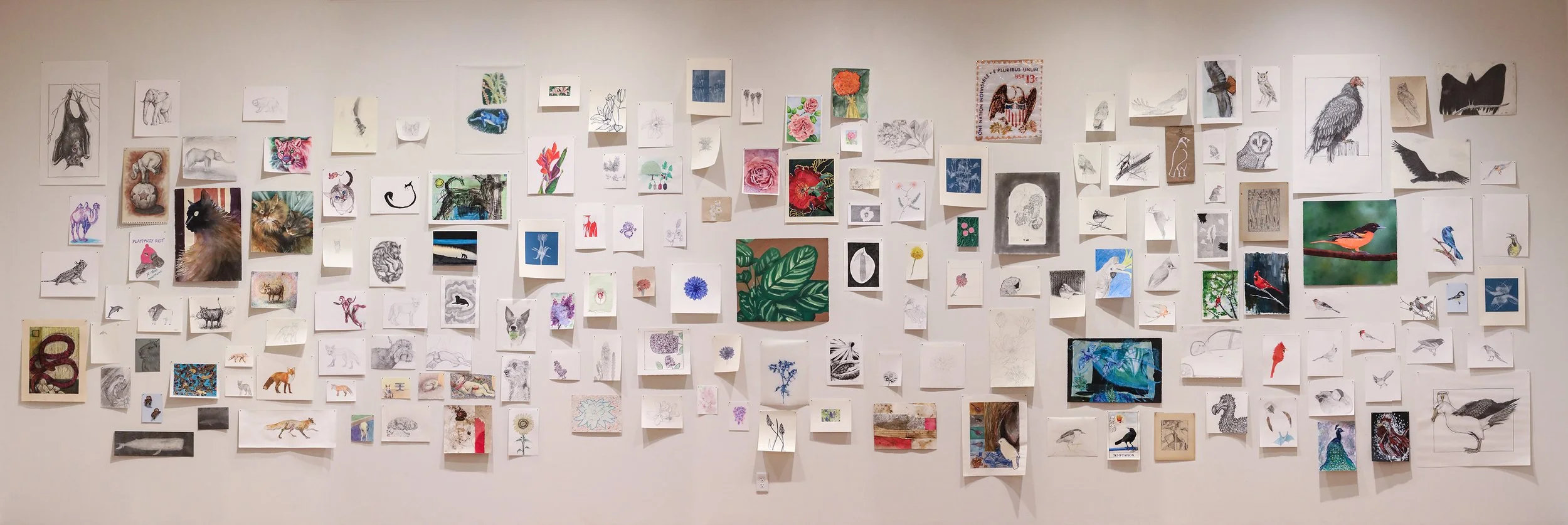
At the end of the first half of the gallery space is a wall full of small drawings and paintings. Titled 20 Questions, these pieces were created by close to 50 different artists, including Resnick herself, based on the answers given in the surveys. Remaining unframed, the wall with participants’ works was inviting and compassionate. For a moment, it didn’t feel like we’re inside one of the major art centers in Salina. Instead, I was transported back to my school days, looking at the glass display cases in the hallway where student essays and artworks would be pinned to be admired by peers, parents, and faculty.
The ‘community wall’ captures the importance of being seen and being told of that fact. It also points to a sense of dismissal and invisibility that tends to sow the seeds of resentment and division. ‘Did you even read what I’d written?’ ‘Do you even listen when I’m talking to you?’ We’ve all asked these questions, or at least wondered secretly when we step away from a seemingly engaging conversation or after we type up a long feedback email. Through this participatory installation, Resnick validates her audience’s existence: ‘Look, I read every single one of your surveys, and I made it part of my next exhibition.’
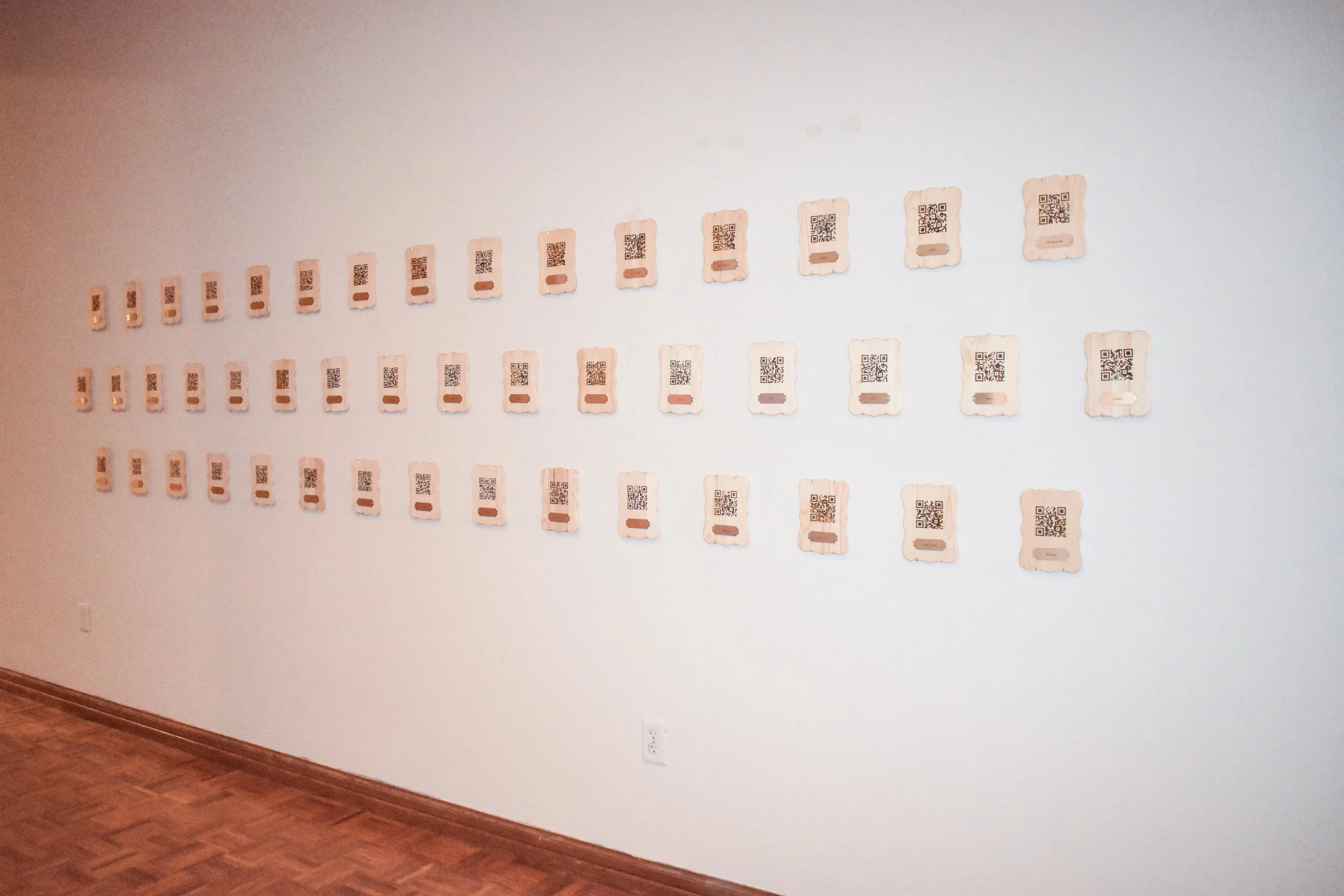
Turning left from the ‘community wall,’ the viewer is greeted with a matrix of 46 small wooden plaques with QR codes. Each leads to a one-minute personality assessment recorded by professional tarot reader Jo Kelly. “In the oracle, the element of fire rises around you, dynamic, instinctive, and ready to move. This is the energy of the card that’s drawn for you,” reads Kelly for Jax 76. Then, “Your Aquarius sun adds vision and innovation, carrying ideas that reach beyond the horizon,” for Dadepi. I didn’t know any of the survey responders, but after listening to the reading, I felt like I could imagine each of them: whether they’d speak with confidence or softness, if they’d jump on a wild call for adventure or sit with me to read in a quaint cafe, would they stay up and chat over a beer and a smoke, or if they’d rather wake up early and share a fresh pot of tea.
I picture participants coming to the exhibition just for their readings with sibling, friend, or partner in-tow. “That’s totally me,” they’d say, if the reading felt accurate. Or, after complaining “I’m nothing like that,” their companion would comment back with a “Nope, that’s 100% how you were.” I imagine giggles, playful pouts, maybe a light punch on the arm if a comment went too far. When they move on, would they have gained new understandings about themselves or the person standing next to them? Would they listen to the other readings?
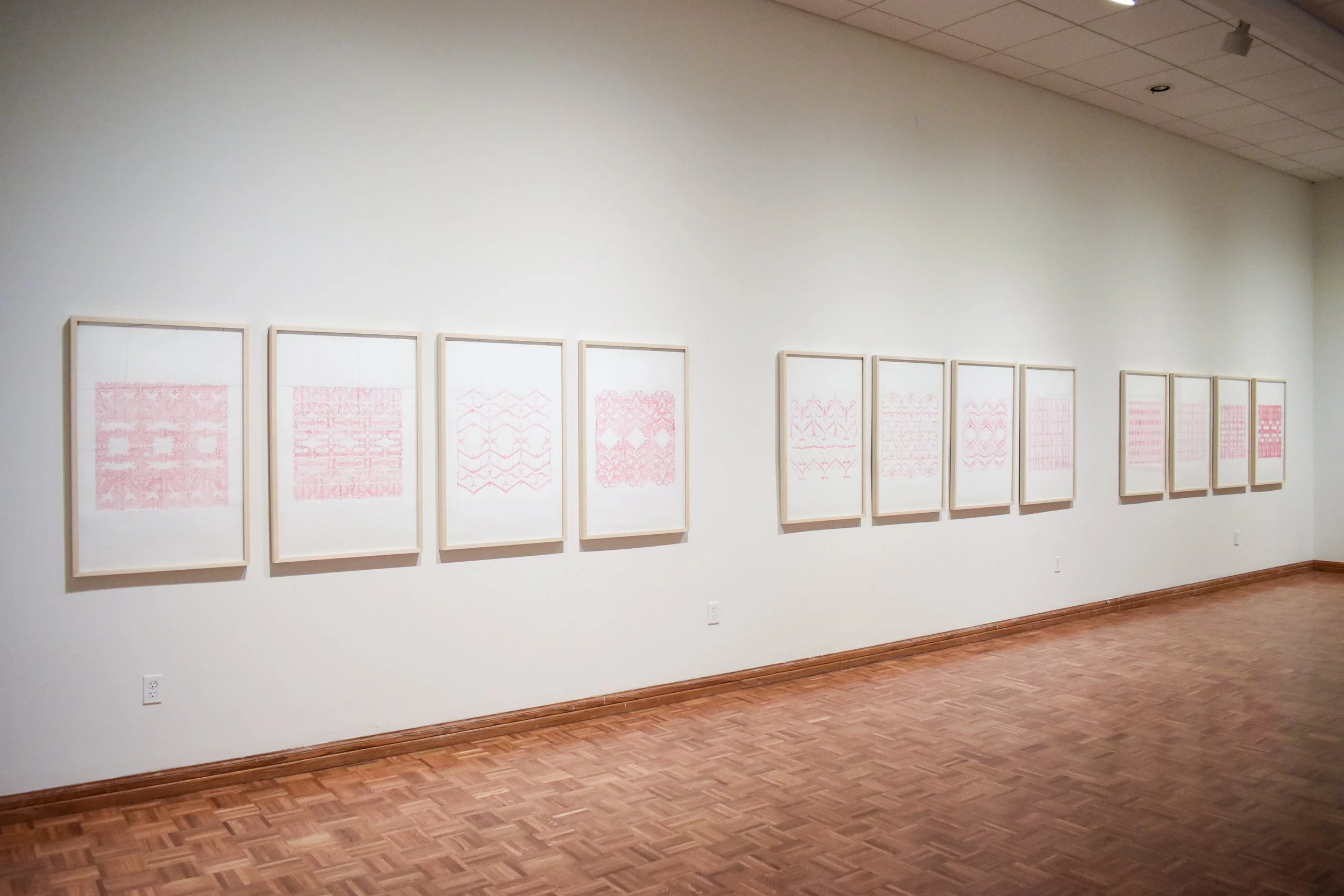
Walking around the corner through the tarot reading hall leads to the last room which houses two bodies of work: Pattern Recognition, featuring 16 watercolor drawings named after MBTI personalities, and Sampler, another massive installation of 60 sheets of watercolor texts.
MBTI personalities are often mentioned side-by-side with archetypes. The 16 personalities are formed around four pairs of mirrored traits: Introverted/Extraverted, Intuitive/Sensitive, Feeling/Thinking, and Judging/Thinking. It is said to be the most accurate personality categorization, and has evolved since its inception to now include sub-personalities under each of the 16 primary categories.
Building on that system, Resnick created perfectly mirrored designs using watercolors on paper. Some have more rigid lines whilst others are curvier. Some are more complicated, covering the square space in the center of the paper with astonishing complexity, whereas others leave large areas of blank spaces between red lines. For someone unfamiliar with each personality, it would be a guessing experience to conclude the traits based on how the drawings felt in their eyes. Perhaps the smooth lines trigger feelings of softness, safety, and understanding. Or do the sharp, pointy angles remind of someone who is heartlessly logical? As humans, we are inevitably burdened by preferences and biases. We’ve all disliked someone because of something they’d said and done when, perhaps, we should’ve given them more patience and grace. Then, maybe we could understand each personality more when it’s transformed into a breathtaking design. Maybe we’d be more forgiving and regard the differences in human characters with curiosity instead of condemnation.
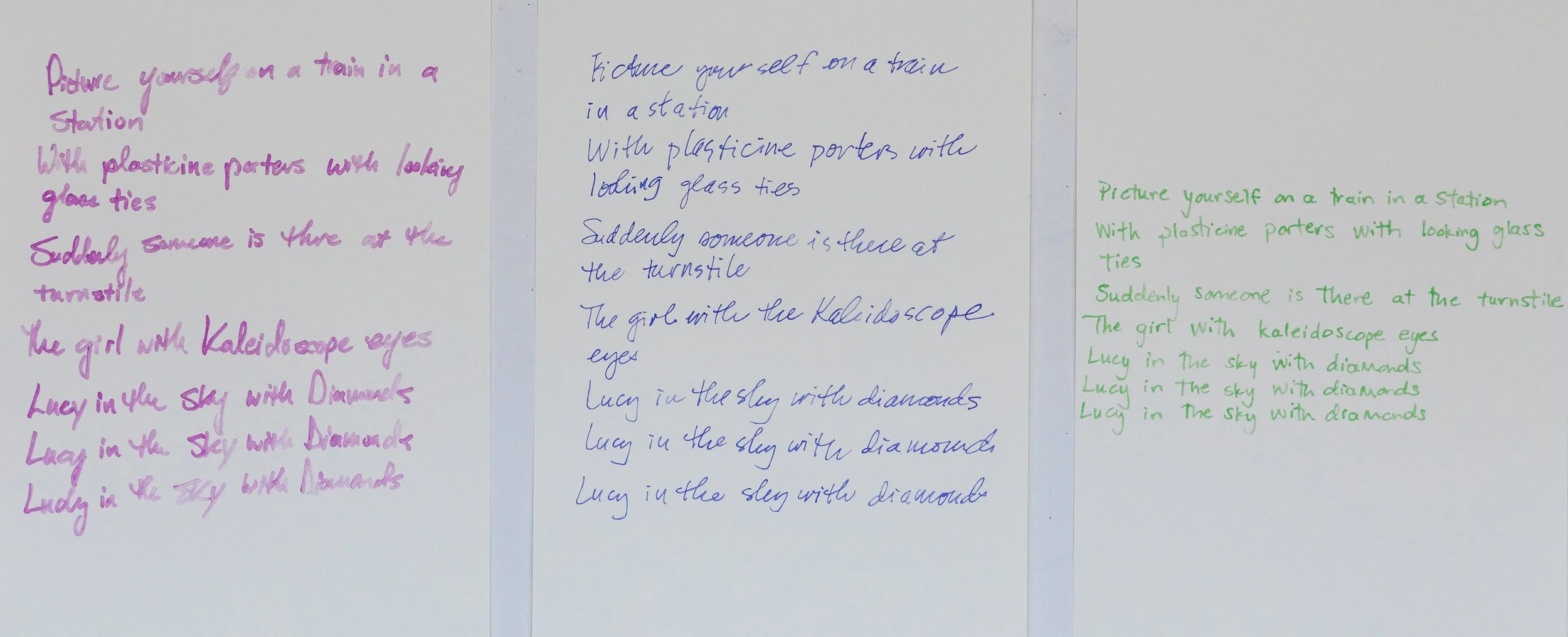
Across the wall from Pattern Recognition, 60 sheets of paper with writings are laid out from-ceiling-to-floor. The originals were written by survey participants and other volunteers, but Resnick painstakingly traced and transferred them using watercolor onto larger sheets of paper.
The writing contained lyrics from “Lucy in the Sky with Diamonds” by The Beatles—a surreal song inspired by John Lennon’s son, Julian’s drawing of Lucy O'Donnell, his classmate, surrounded by stars. The lyrics picture a bedazzling girl who seems to be everywhere: on the train, in a boat, down the bridge, by the fountain. But when you turn or try to catch her, she’s gone.
I’d always thought the song to be about unattainable innocence; the type of surreal idealization that likely wouldn’t happen in the real world but you dreamed of it regardless. Having so many different hand-writings repeating the same longing paragraph had constructs a powerful sense of unification that makes my body vibrate and tremble. It felt like someone was whispering in my ears, telling me that they’d felt like that too: wanted a better world, hoped for universal harmony, wished that everyone would just get along no matter how different we may be. In a folder nearby, graphoanalyst Ed Rath created detailed analysis based on each person’s handwriting; assessing participants for their emotional responsiveness, depth, mental processes, imagination, social aptitudes, integrity, capacity for action, and other elements.
Who’d have thought handwriting could reveal so much about oneself?
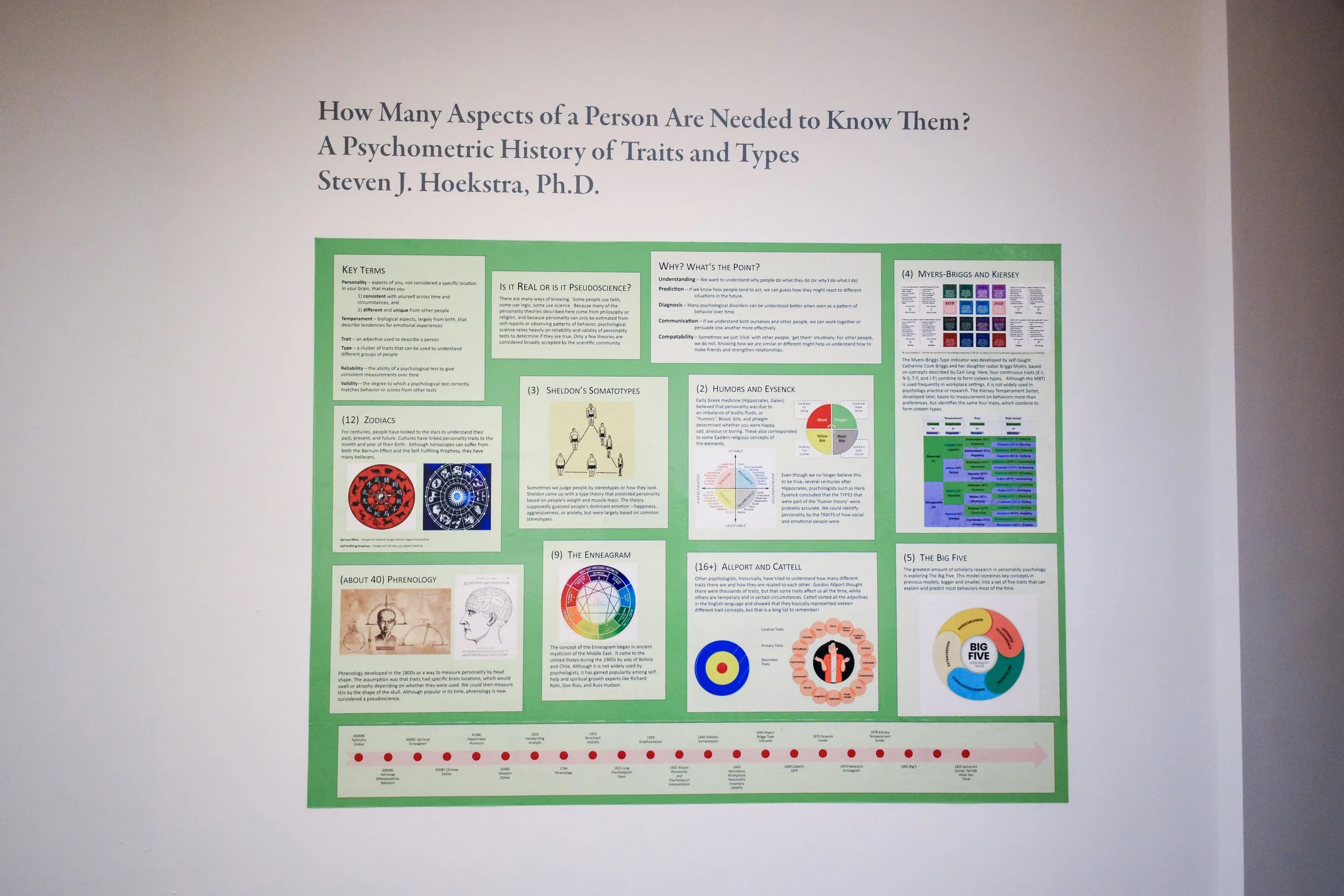
One thing that caught my attention in the exhibition was an historical presentation titled How Many Aspects of a Person Are Needed to Know Them? It was a brief presentation of different systems we’ve come up with to analyze human behavior, including zodiacs and the MBTI. The presentation sits between Pattern Recognition and Oracles (the tarot readings), and could’ve been easily missed by the audience.
It only takes a few seconds to reveal how much effort we’ve spent as a species to understand others (and ourselves). Yet we get squeamish with the idea of ourselves being perceived by someone else. The irony becomes only more significant once you realize that the easiest way to establish common ground is likely to just talk to the person.
How many fights could we have avoided if we’d just talked?
How many conflicts could we have thwarted?
How many victims spared?
Tell Me What You Think of Me is a manifestation of that stubborn, relentless desire for things to get better through understanding, compassion, and communication. It’s a call for openness, a plea for us to simply share our thoughts with each other.
“Tell me,” Resnick demanded. Then, she told the participants what she’d learned about them through their responses.
And look how quickly we began to get along and have fun.
By Xiao daCunha
Images: Salina Art Center