Interview with Dolores Coe
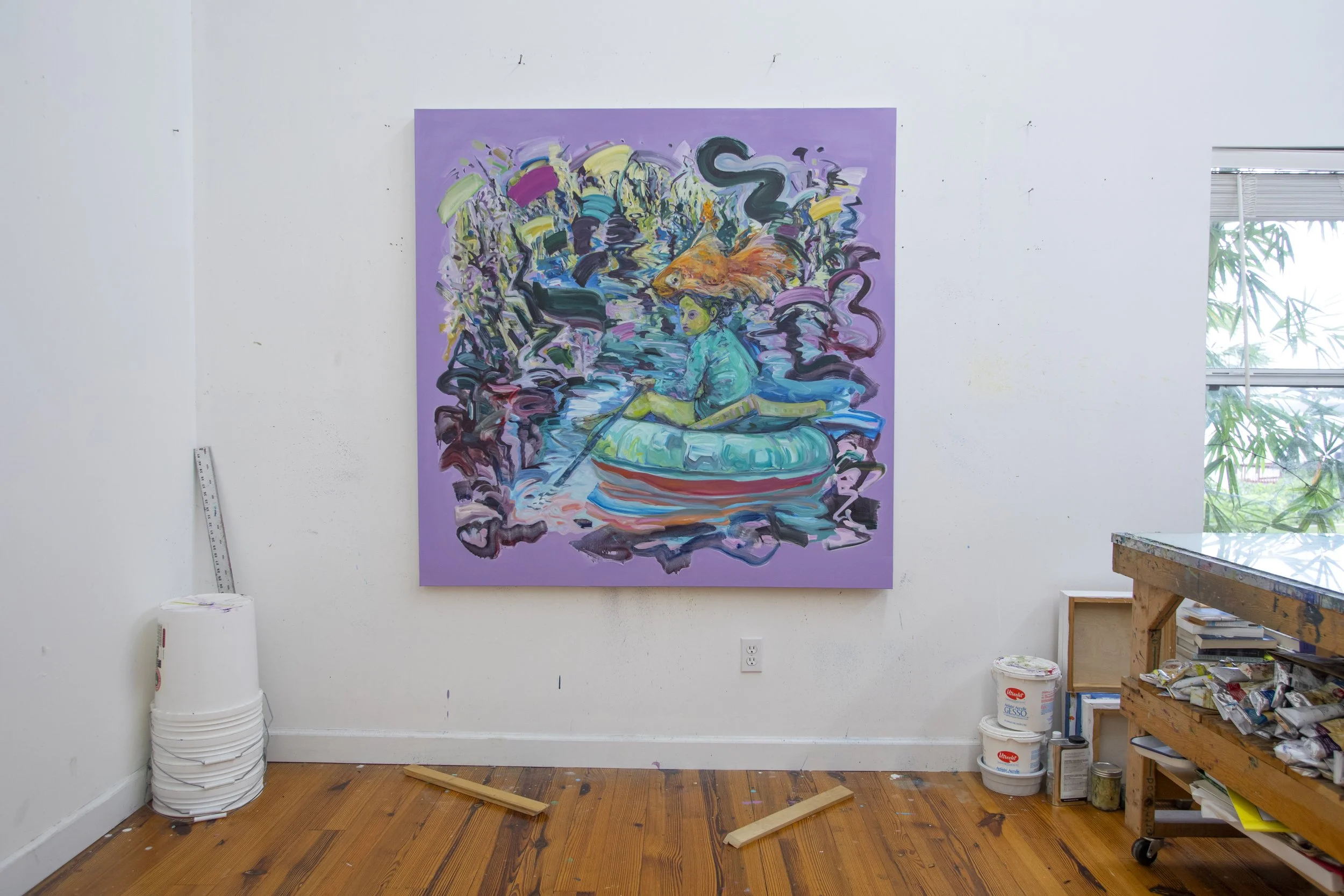
Dolores Coe is a painter from Ruskin, Florida. Her world of inverted colors and artificial saturation is a psychedelic reality that has previously depicted found scenes and fake animals, and her new series focuses on the experience of the COVID kids. The paintings aren’t so dissimilar from our backward, upside-down society.
Eleanor Eichenbaum and I joined Dolores in her home studio, which was bright with daylight, and overlooks the Little Manatee River, to discuss her paintings, teaching in the early days of Ringling College, and what it was like growing up in Sarasota.
Eleanor Eichenbaum: What is your creative process?
Dolores Coe: The process that I use—these have more representational elements than some earlier ones, but whether abstract or representational, I’m working in the same process, which I began while in Oaxaca. The photographer Wendy Ewald developed a way of community and groups in collaborative photography projects, and I was interested in her process. So, I joined a photography workshop in Oaxaca that she was leading. It was all photographers and me. I was basically learning the process, and trying it out, and at the end we had to have an exhibition. My photos were very mediocre, so I was interested in grabbing these fragments of things. I had nothing that was a ‘photograph.’ I received the prints, and started combining unlike things with scotch tape on the back, and with gouache I’d brought, I started painting over it, leaving some things and inventing other things. They weren’t great, but I knew there was something there. I was looking for different ways of suggesting, for ambiguity that opens to various narratives or interpretations. It was kind of a perfect process. It’s a process that’s somewhere in between real and not real.
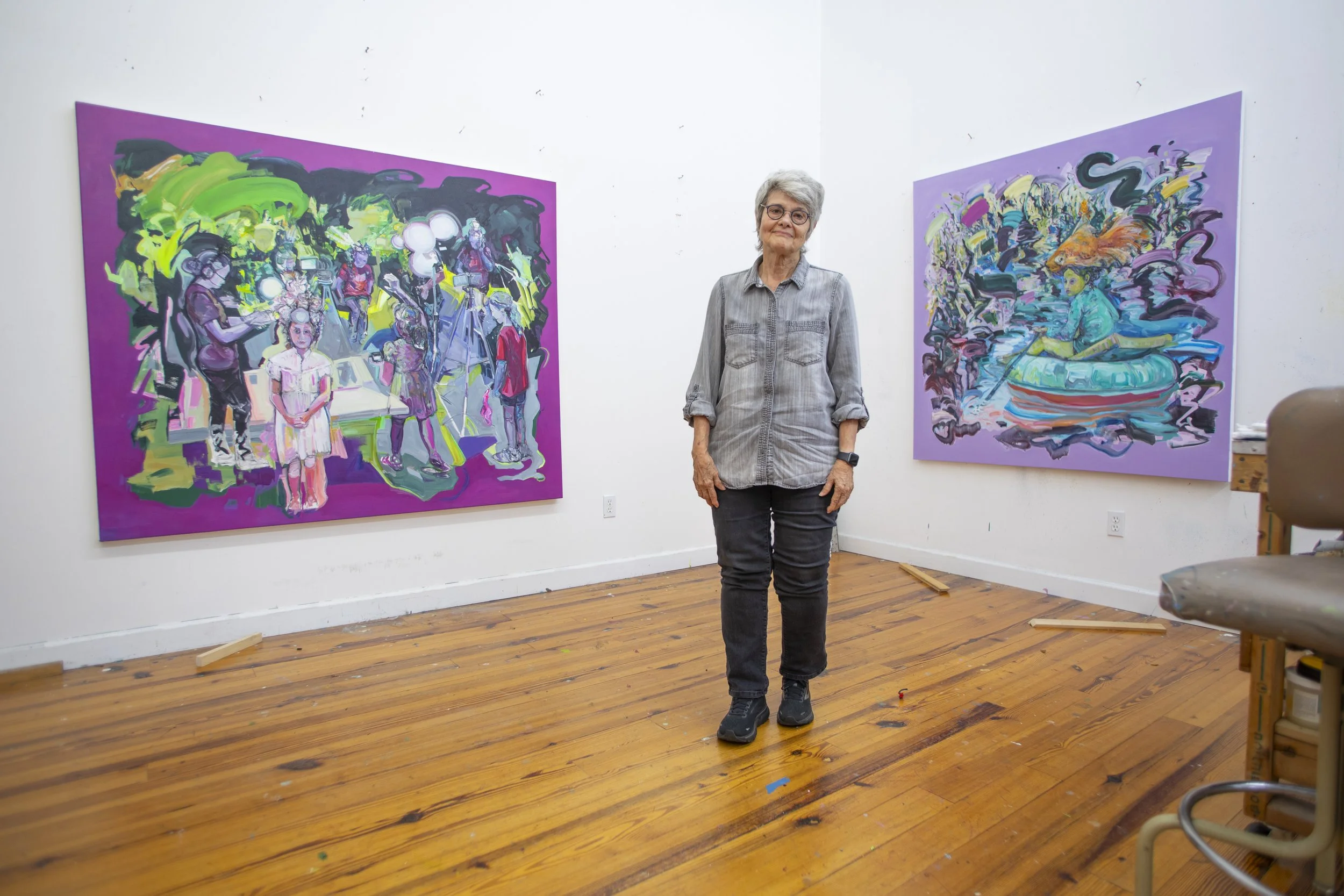
Tom Winchester: The word ‘fragments’ makes me think of postmodernism. When I look at your work, it definitely looks like a ‘grab-bag of styles.’ It’s like your work has the content of a David Salle with the color palette of a Peter Halley.
DC: The other parts of the vocabulary that are important to me are the gesture and the agitated environment. If you factor out the color field that they’re embedded in, they’re very chaotic, active environments that don’t stand still and that don’t really make sense.
EE: The motion is really tangible in the way you make them.
DC: The figures and animal forms, when extracted, are frozen in motion. So, it’s really important that the field is really charged and active. And these are all things I didn’t think about ahead of making them. They’re things from the process, from the beginning, that I discover. It’s when I put them together that they suggest something to me.
TW: The border reminds me of Georges Seurat’s A Sunday on La Grande Jatte that has a very unique, pointillist, multi-chromatic border around it—which is often excluded in reproduction. In person, it’s surprising how thick the border is. It’s clearly part of the piece, not just a border.
DC: The color field is something that came up for me in my previous series of animal target forms. For me, in addition to collaging photographs, it’s another way of extracting fragments from events and putting it in a new space. Like with the animal targets, it looks like they’re in nature, but the color is lime green or violet to suggest being out of place. In the new paintings, the color fields are suggestive of children’s plastic toys, especially girls—you know, Barbie—but not to reproduce those as they are, but rather to ‘turn it up.’
EE: In person, looking at your paintings, I like how the gestures stand out against the background color. When you’re painting, which comes first? Does the background color come first? It seems like the spine that holds the whole book together.
DC: Yes, and a number of other painters have asked me, “Have you ever thought about just painting to the edge?” I go, “Yeah, I think about that, but it would fall apart.” It would have to be a different painting, and have different anchors within it, but that’s not what I’m after. I’m after those things functioning to let you know that this is a fragment, it’s not a complete thing that you’re seeing.
TW: How do you decide which elements to render and which elements to make abstract?
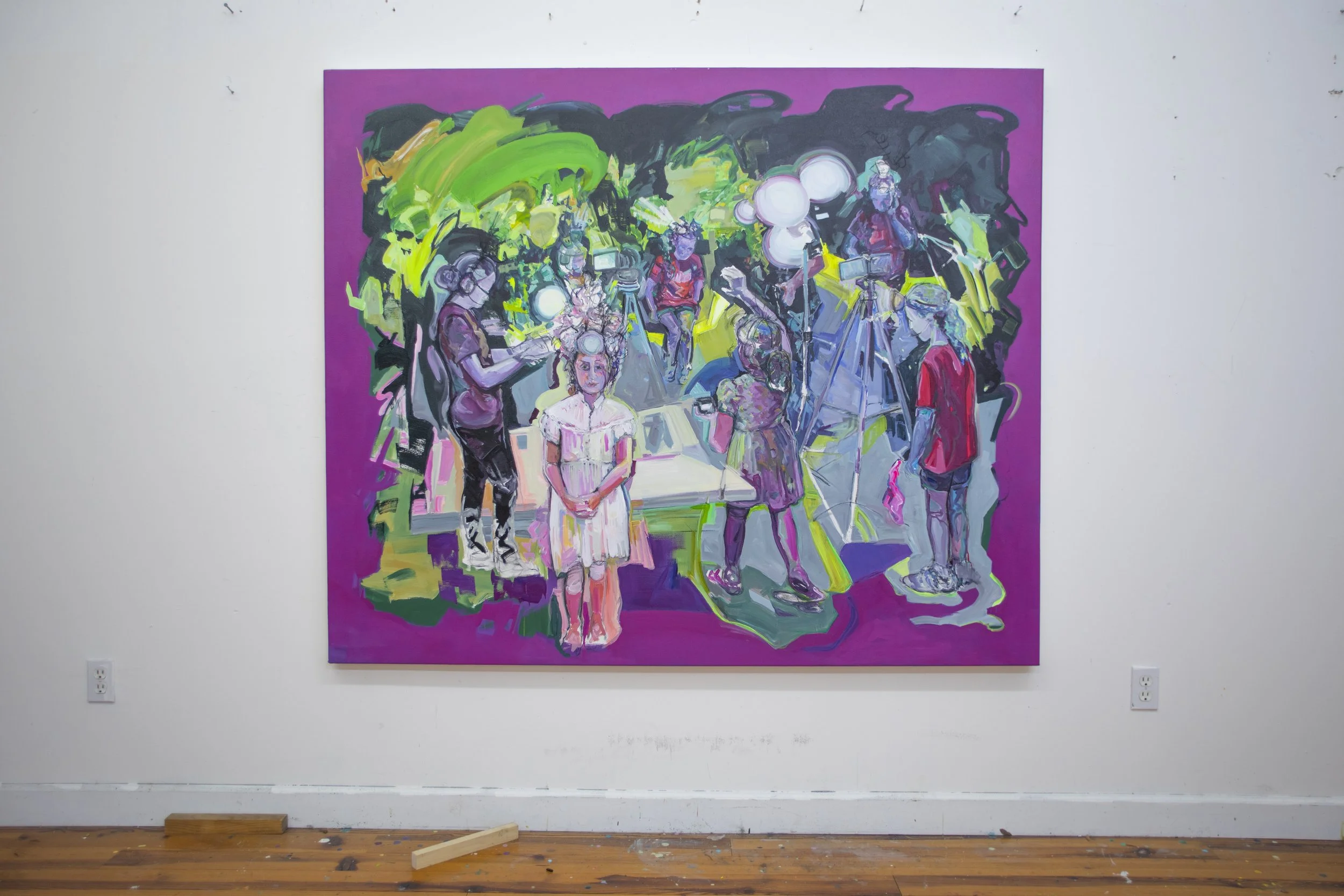
DC: Having the two come together is the task. Being hungry for representation by conveying the figures of the children, and the abstract qualities are essential to me. They create the dynamic. Having those two things live in the same world, and how they’re going to come together is a ‘problem.’ For example in one painting, the ‘problem’ is that it’s too one way or the other, and I’ll be trying to resolve that as I go along.
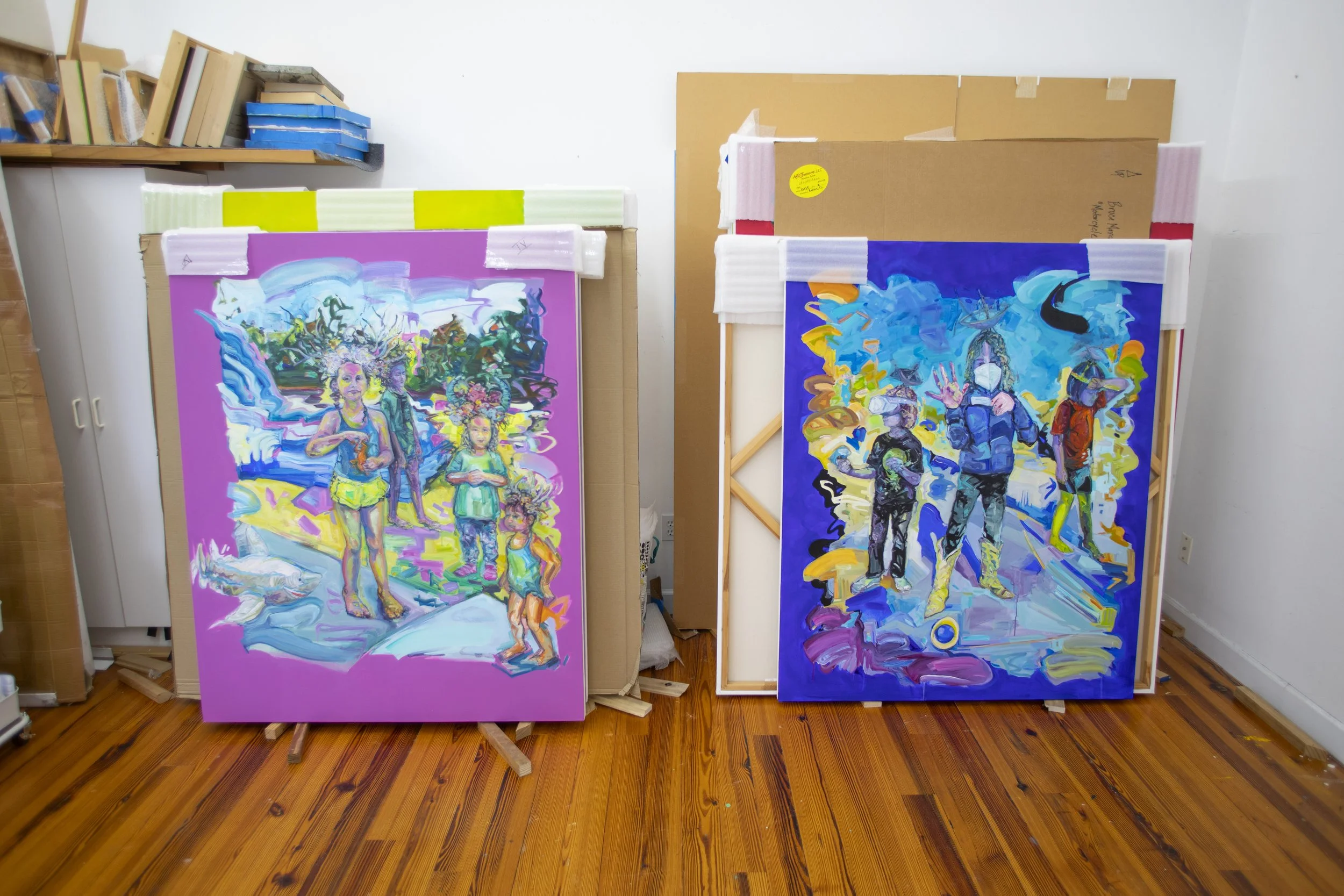
I hadn’t been doing figurative things for a long time, and then came the pandemic. Everything closed down, there was no place to show anything, I was continuing the series that I had going on, and then my niece shared with me a picture of my grand-niece with her friends, during COVID, they were all girls, and they were looking at the camera, kinda ticked off that she was taking a picture, and just the look on her face—I texted her back and asked if I could use it for a painting. I told her it’s not going to be cute or pretty, she knew the kind of work that I do, and she said, “Yeah just use all you want.” I was thinking about how it must be to be a kid growing up during a pandemic, and the psychological task it’s taking on them.
I didn’t mean them like Lord of the Flies, but I do mean them as these beings on some unspecified project, that they’re linked together, and the headdresses were spontaneous. A couple of the kids had something on their heads, and I just started playing with paint and made them all have headdresses, it grew with the paint. It’s something that kids do. They don uniforms as if “This is our team. These are our comrades.” But it’s also what warriors do, or how we signify that we’re part of a group.
I start with charcoal on canvas. Big drawings. I always learned, and I also taught, in painting, that you don’t start with big charcoal lines and then go into it with oil paint.
TW: But that’s exactly what you’re doing.
DC: That’s exactly what I’m doing. I just had an impulse. Maybe something about the strength of the figures, or wanting to connote the posture, so I just started by drawing. Then, the field starts to come next, and the color, and then I start to work into the figures. I have a source, but I never use the colors from the source.
TW: It’s interesting you characterize the head pieces as headdresses. They remind me of an August Sander photograph called Rural Bride (1920-25), in which the subject wears a wedding crown.
EE: Were you making art as a young person?
DC: I was drawing on everything. My father would bring home big pieces of paper, they were electrical charts, boxes of them, for us to draw on. My senior year in high school I took an art class, and the very first day was a test on perspective, which I failed. So, I was always doing art as a kid, but not formally.
EE: The paintings have a sense of the landscape of Florida.
DC: I grew up in Florida, and it’s such a mix. I was born in Sarasota. My neighbors, a couple streets over were The Flying Zucchinis, which got shot out of a cannon. They would keep the cannon and the net to catch them in the backyard, and we’d ride our bikes by and watch from the street. I had a wonderful piano teacher down the block the was next door to the wrestling ring. There was such a mixture of people. And in junior high I was an usher as the Asolo. So, I had the experience of all these people, from all over, that’s different from what people may think of as the stereotype of Florida.
Here, in Florida, it seems everyone’s either running away from something, or coming here to do something. There are transitory waves. This area, Ruskin, was started as one of the four idealist communities based on John Ruskin. They were based around a little college here. Women were allowed to vote here long before anywhere else. There were women faculty at the college.
TW: This neighborhood, Ruskin, is the real Florida.
DC: If you scratch the surface of any place, there’s rich material underneath. Florida isn’t consciously in my work, but the combination of my experiences, the kitsch, the remnants of all that’s been here, really has been an influence to me.
By Tom Winchester