Honoring the Messy Beauty of Motherhood
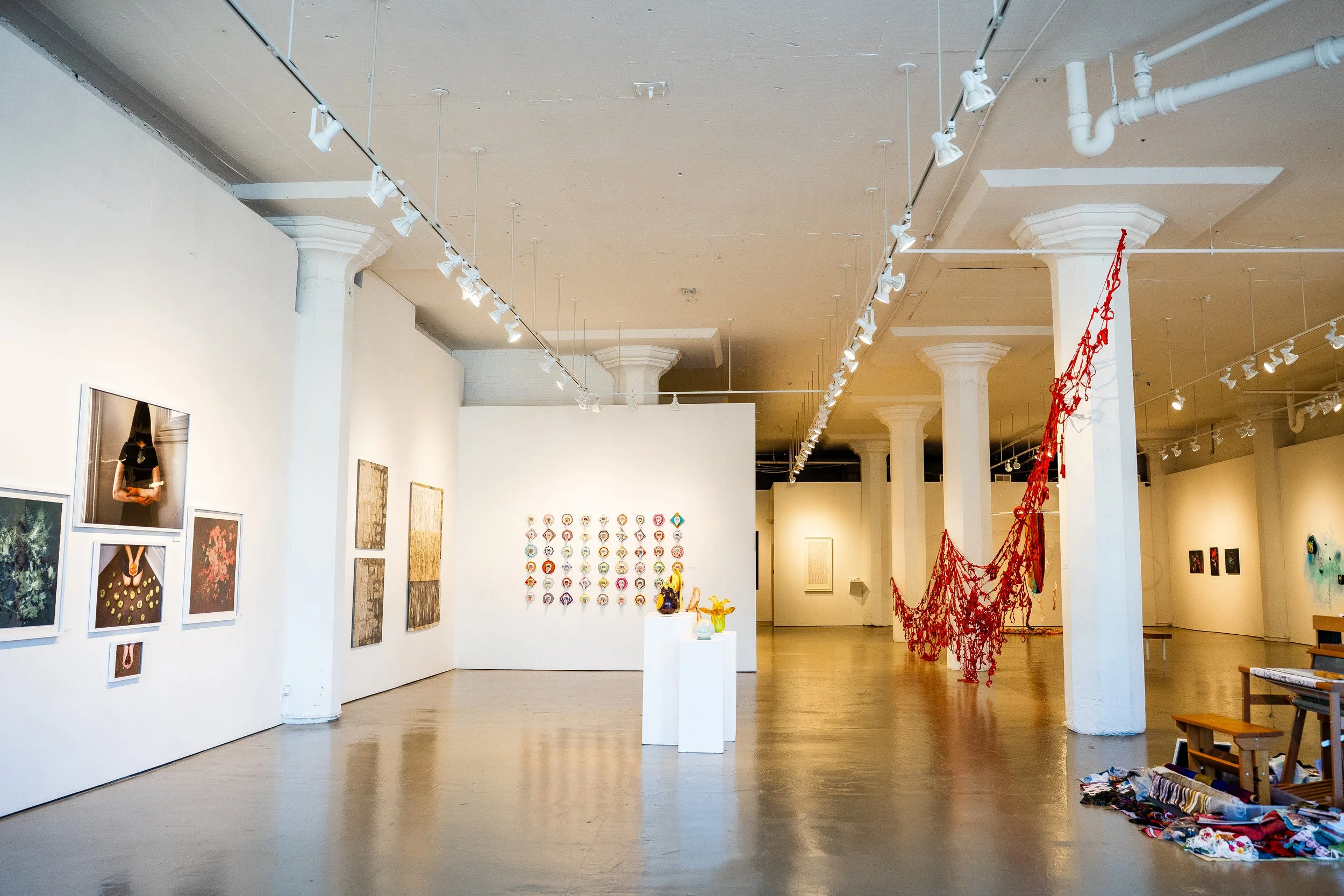
The closest I’ve experienced when it comes to motherhood is being a bunny mom: and that creates enough stress on top of juggling all my plates. I could not fathom being a human mom and being anything else at the same time. Imagine having a newborn while preparing for a museum exhibition, or working two jobs then getting accused of being negligent by your teenage daughter.
Behind every success story of a single mother who completed a master’s degree are probably unseen tears and nights after nights of self doubt and heartbreak. Even in a happy family, the mother’s life tends to be full of confusion, frustration, and distress because, inevitably, motherhood comes with sacrifice and bargaining: the new role demands the woman to change the focus of her life from herself to her child. The label is so strong, that a woman is often reduced to little more than her maternal duty in the public and private eyes. In The Mother and… Project at Kansas City’s Leedy-Voulkos Art Center, curators Eleanor Lim-Midyett and Courtney Wasson decide to restore the three-dimensionality of the flattened matrons by presenting them as living, musing, inspiring human beings: the artist-mothers.
The exhibition features 18 artists based in the Kansas City metropolitan area and beyond: Debbie Barrett-Jones, Rahele Jomepour Bell, Laura Berman, Mona Cliff, Julie Farstad, Nancy Friedemann-Sanchez, Diana Heise, Cory Imig, Sarah Irvin, Priya Kambli, Samantha Krukowski, Linda Lighton, Beili Liu, Sukanya Mani, Adrienne Maples, Amy Meissner, Althea Murphy-Price, and Sonié Joi Thompson Ruffin. Participating artists work in different media and disciplines, and are in different stages of their artist career and motherhood, with children varying in age and identity. Many of them came from traditionally underrepresented and marginalized communities, adding another layer of complexity to their experience as both artists and mothers. At the heart, the exhibition explores the ethics of mothering, or the guiding principles these artists follow in raising their children in a world that grows increasingly hostile and biased, while springing forth stronger narratives of compassion and equality. In return, this ethical network informs the women’s creative practice, bringing new light onto the materials, methodologies, and narratives in their art.
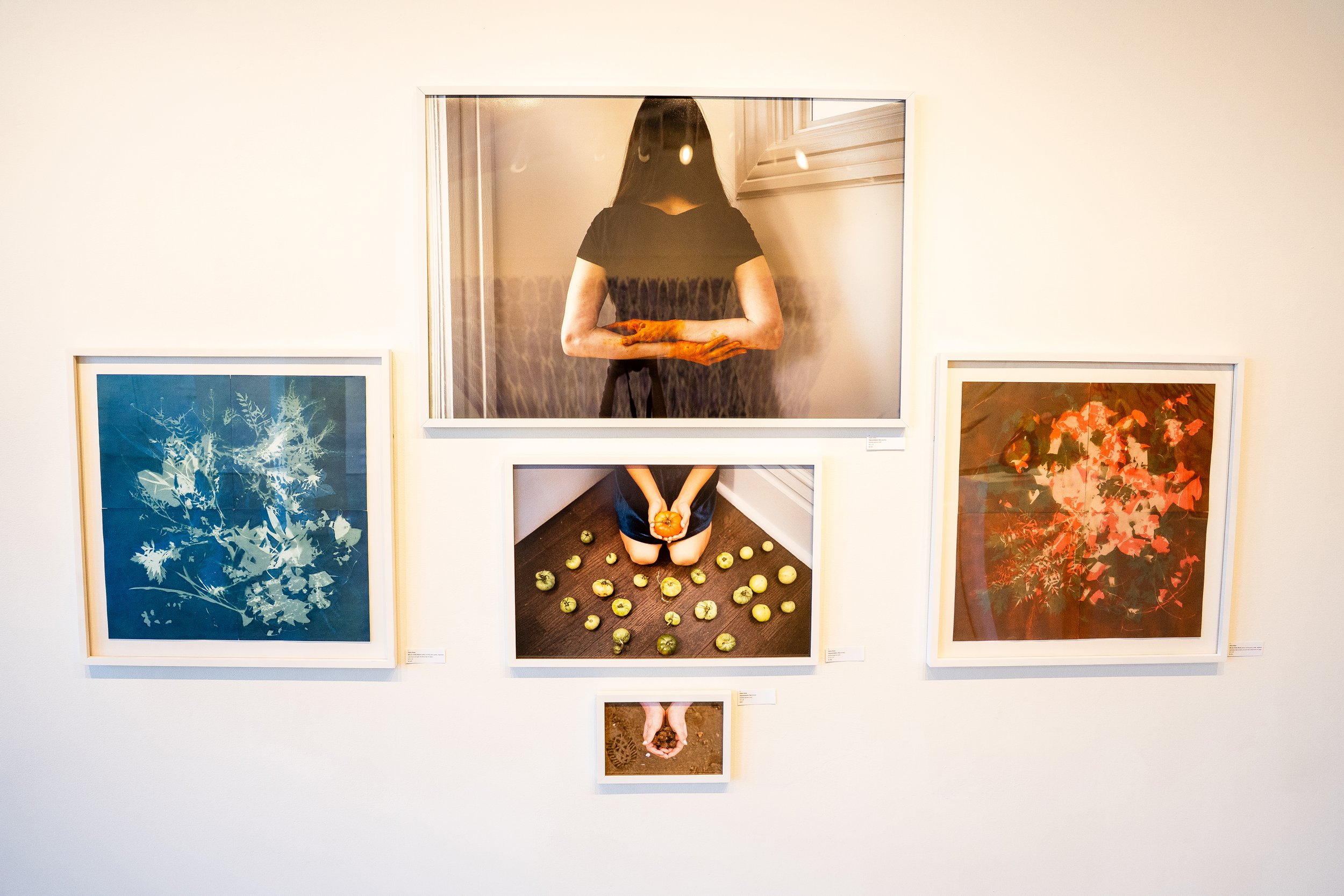
Because motherhood is often filled with house chores, many incorporate daily household objects into their creative process. In her photography and cyanotype work, socially-engaged and research-based artist Diana Heise uses spices, vegetables, and yard weeds as building blocks. Here, tomatoes, clover, nettle, paprika powder, thistle pods become carriers of Heise’s emphasis on connecting with nature. In Deassimilation Diet (tomato) (2017-ongoing) Heise kneels between scattered green tomatoes while holding the only ripe, orange one in her hand as if thanking nature for giving her and her child food. The similar pose was repeated in Deassimilation Diet (thistle) (2017-ongoing), but this time Heise holds a bundle of thistle pods with seeds that will sprout the native plant. The posture in both photos is similar to the one used to scoop up water from a fountain or receive holy blessing from a higher being. The colors feel washed out, rendering into subtle shades of grey, sepia, and amber. The brown of the wooden floor resonates with the brown of the soil. I wonder about Heise’s children. I think they’d grow up to be fine, humble adults who respect nature, and find joy and delight in the veins of a simple leaf. And that makes me smile.
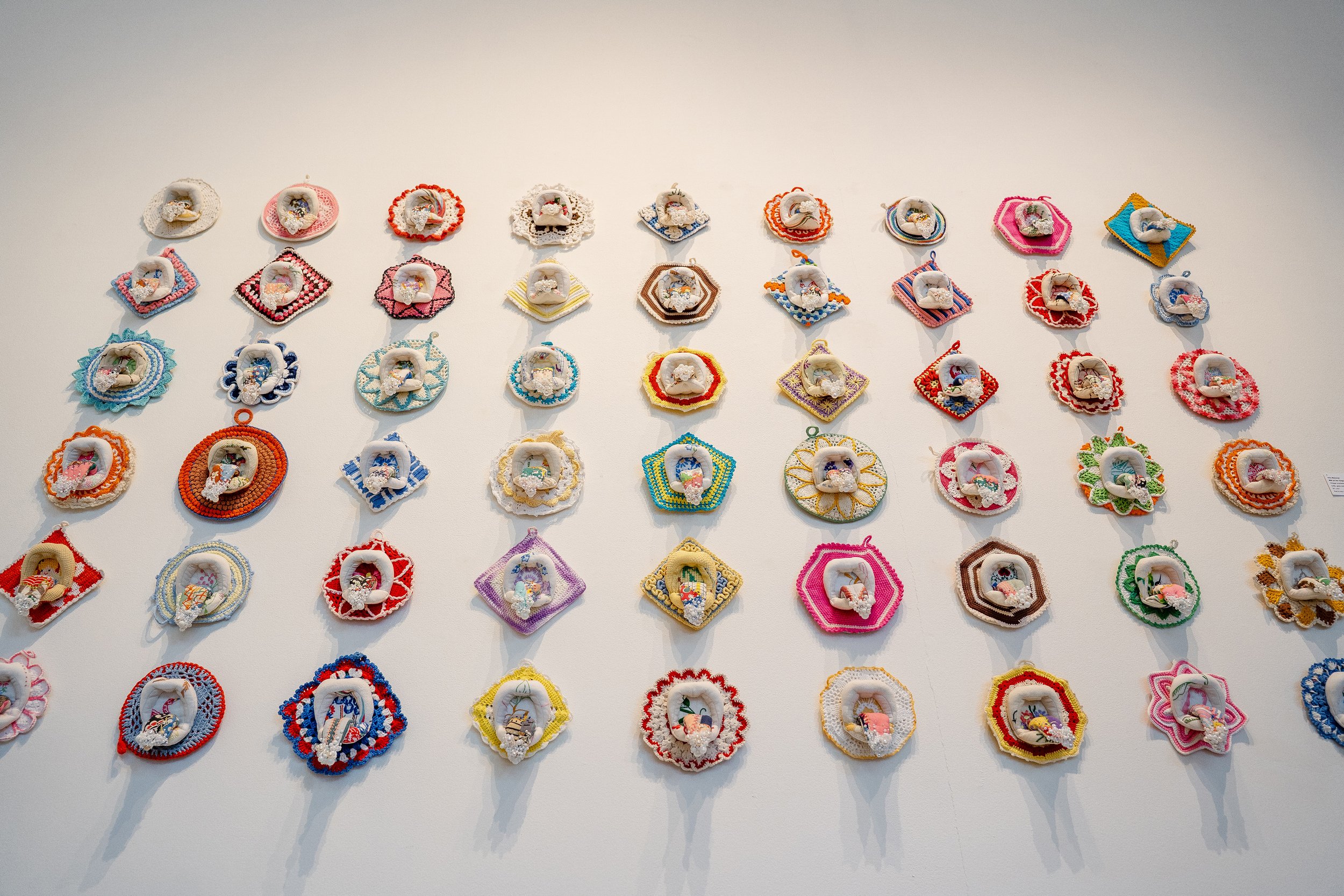
Other artists find creative sparks in the messiness of motherhood. May it be the unpredictability of a child’s mind, or the physical chaos that unfolds as the baby grows. Alaskan artist Amy Meissner presents a grid of colorful tongues transformed from vintage crocheted potholders and abandoned crazy quilts. Titled Milk on the Tongue (2022), these pouches, with their colorful crocheted edges, almost look like a swarm of imaginary dinosaur monsters. The tongues, embellished with embroidery, plastic beads, and crystals, dangle out of the pouches. I picture a kid sticking out their tongue, pointing a finger to the streaks of color left behind by their Halloween-themed cereals—or was it the bizarre green from Lucky Charms with marshmallows—“Mom, look!” Either way, they seem to be quite fascinated with their now orange-and-purple or green-and-yellow palettes. Do they pretend to now garner magical power, or have they been poisoned by evil minions? There is no logic in childish joy. It’s messy, silly, and unreasonable. And it’s eye-opening for the mother, or any other adult, who might need some help finding lightheartedness in the heavy mess of reality.
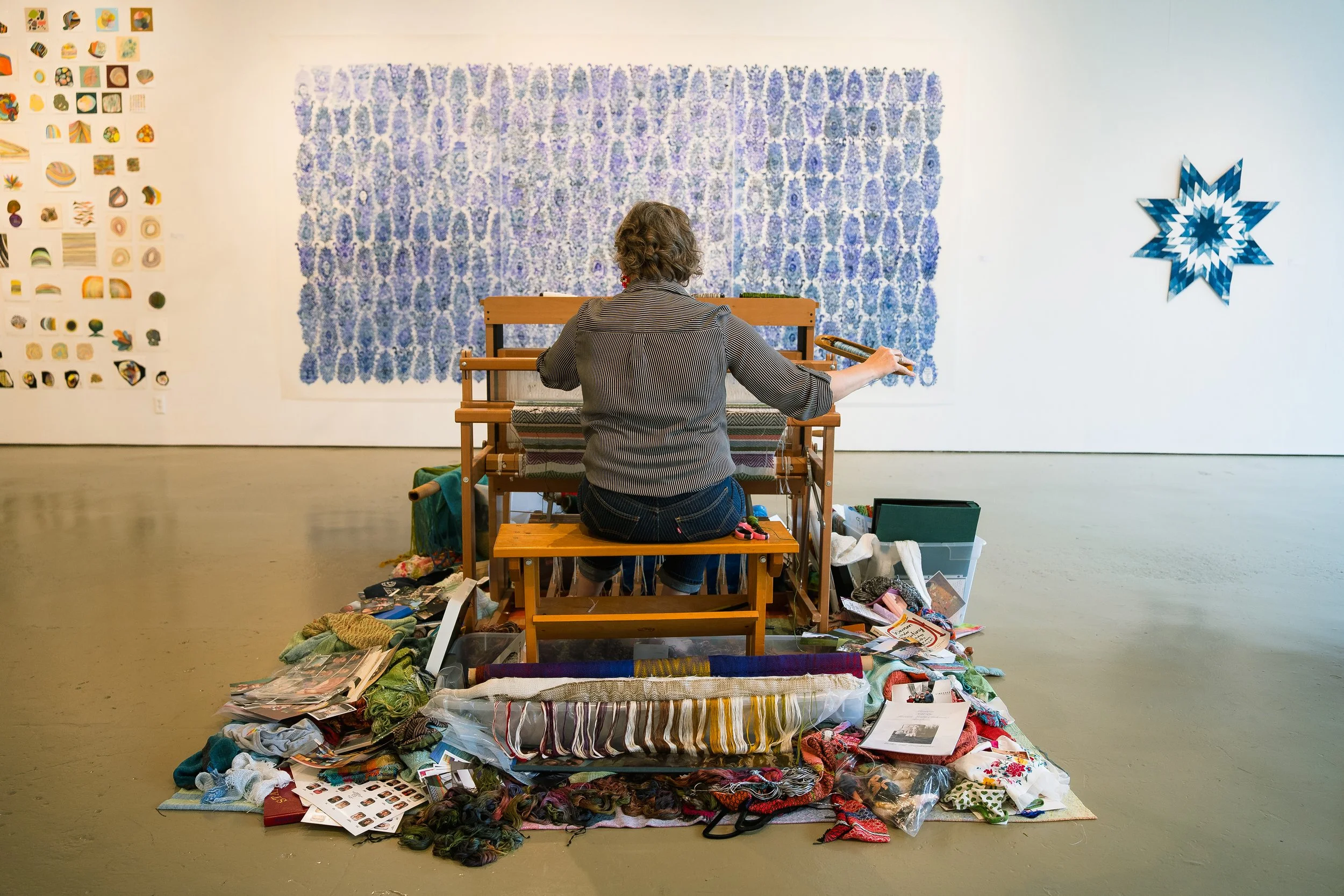
Speaking of realistic mess, Kansas City-based weaver Debbie Barrett-Jones examines motherhood from the physical chaos it entails in her installation. If keeping your fabric tidy around fur babies is challenging, wait until you’ve tried with human babies. In Holding On, Letting Go (2025) Barrett-Jones recreated her home studio environment by setting up a floor loom in the middle of the gallery. The loom is surrounded by scrap fabrics, bins of random objects, old photographs, and abandoned toys. Even the workbench is placed inside a large, plastic Tupperware.
Amidst this disconcerting scene is Barrett-Jones, who peacefully weaves away meticulous geometric patterns featuring neat diamond and chevron designs. The orderliness of the textile, with its sharp design on white background, is the polar opposite of the orderless environment it’s being created under. And what can a mother do when every corner of her being has been touched by her new role other than adapt, morph, and grow into it? Barrett-Jones’s installation and practice carries a mother’s confidence and willingness to deal with whatever is tossed her way. So, I imagine her child, watching mom weaving intricate designs amidst utter chaos, would turn into an equally resilient little warrior ready to navigate whatever life throws her way without losing sight of what truly matters.
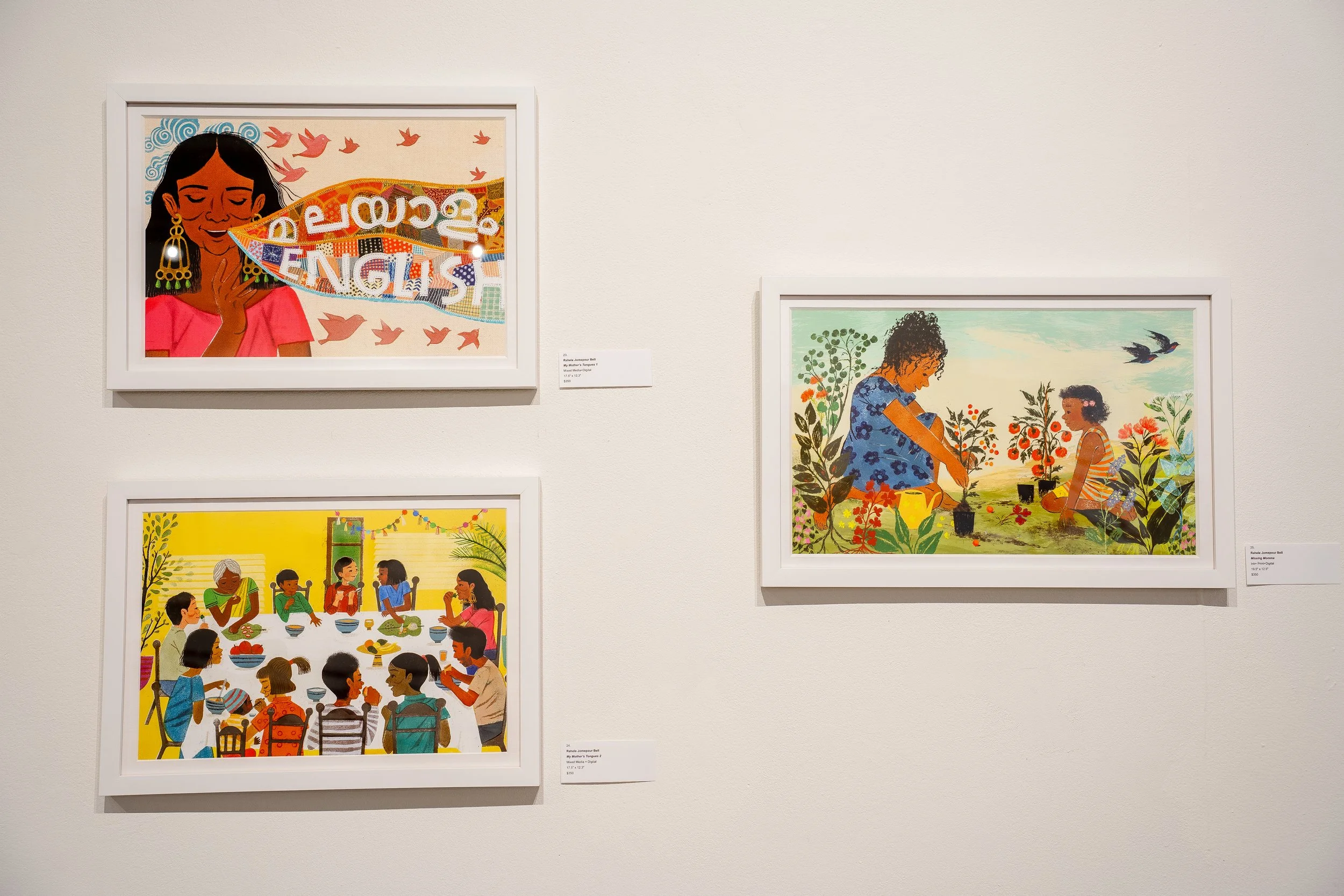
And for some, motherhood is a journey of healing from the loss of their own mothers, and of grieving a distant former home that is now lost. This sentiment is especially significant in the works made by mothers of color and immigrant mothers. In her paintings, Iranian American illustrator, author, and educator Rahele Jomepour Bell combines her childhood memories with her current identity as a mother. The three mixed-media illustrations with digital enhancements draw parallels between her relationship with her child, and the one between her and her mother. Titled My Mother’s Tongues 1 (2023), My Mother’s Tongues 2 (2023), and Missing Momma (2024), the pieces depict scenes from childhood memories. One pictures a family dinner, (is the silver-haired lady the artist’s mother?) and another captures a young girl in a home vegetable garden with her mother showing her how to remove a sapling from the flower pot. There is also the artist’s self-portrait where she simultaneously speaks Iranian and English, carrying the language from her past home and that of her current land. The bright, playful colors do not compromise the powerful narrative embedded in these visuals. Instead, they bring forward the joyous motherly day-to-day, and the complicated diaspora experience. By doing so, the artist builds a powerful narrative of the profound bonds between generations across lands and oceans.
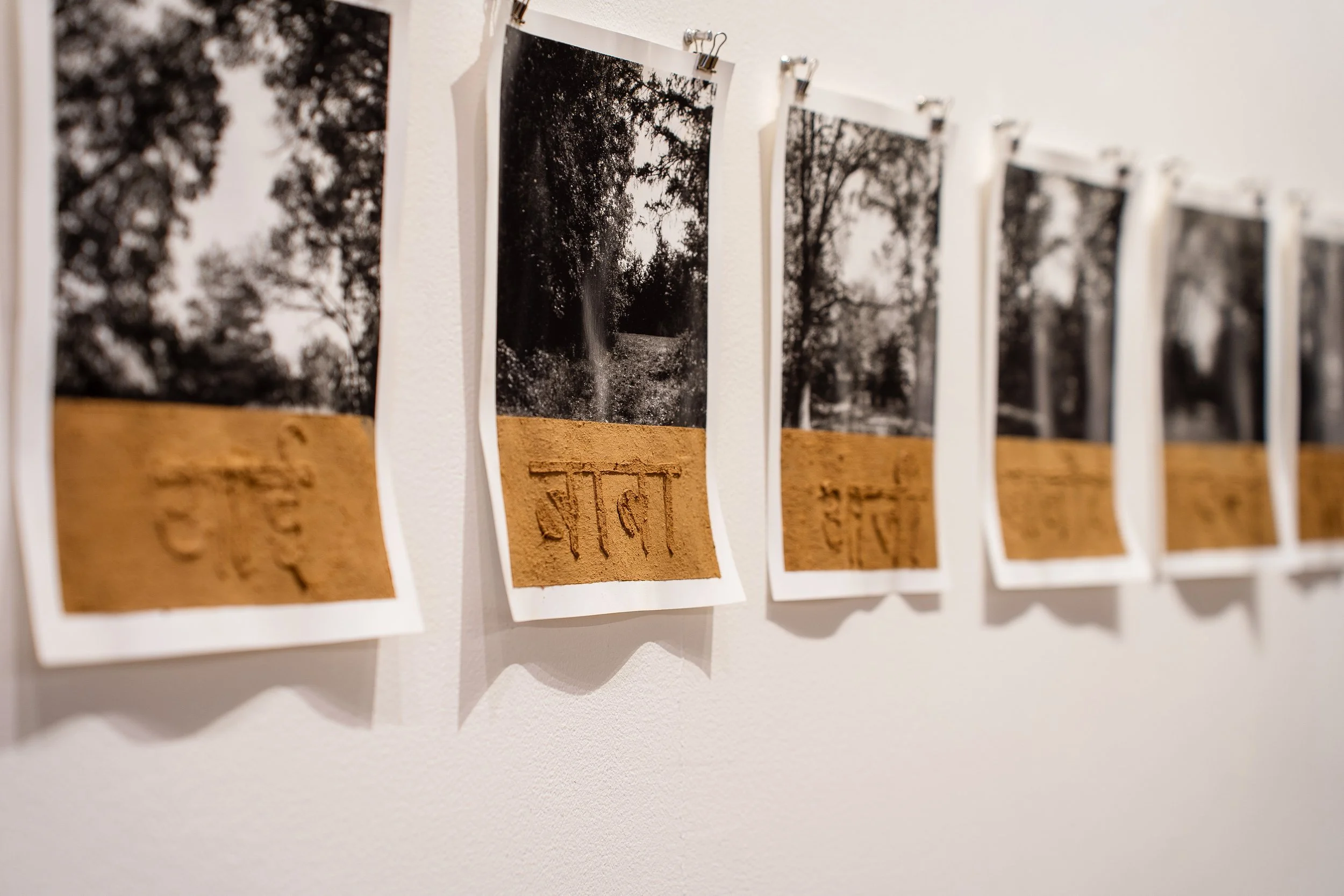
This concept of being perpetually away from home, and the nuances in passing down the unique diasporic identity to their children, is also captured by Priya Suresh Kambli, a photographic media and installation artist born in Mumbai, India. For “The idea of home follows me wherever I go” (2025), Kambli created a set of 11 silver-gelatin prints that capture views from the lakes and woods around her American home. The first 4 prints are interlaced with traditional Indian patterns that show up as subtle, barely visible embellishments. The following 7 have an Indian word on brown sandstone layered over the bottom of the picture. “[This body of work] comes from a personal desire to connect myself to my adopted land, a land which does not hold my past but holds my present and my future. The intention of this work is to draw new lines of belonging and visually consider the questions: ‘How do I, an immigrant, become native to my adopted land?’”[1] To raise a child as a person from a diaspora is to teach them to love two different homes: one may feel so much like an obsolete past for the younger generation, the other an unfamiliar land for the mother even after building a family on its grounds.
Safe to say, The Mother and… Project is a symphony of mothers’ vulnerability and endurance. It is a tribute to the invisible labor these women put into their offspring. While it often demands them to sacrifice their private time that would’ve been otherwise dedicated to their ‘projects,’ it also brings fresh insight into themselves and the world around them. Most importantly, the exhibition reminds us, once again, motherhood is not a monolith, and each mother experiences it differently as she figures out how parenting works: the mother grieves; she gets hurt, frustrated, confused, and scared, too. But the mother will always find a way around it because she must move forward with her children.
There is no doubt that the child is the mother’s project. But who says the mother herself isn’t a work in progress, advancing every day? And what magic will be created as her motherly experience unfolds!
[1] Priya Suresh Kambli, Artist Statement, The Mother And… Project website, https://www.themotherandproject.org/artists/kambli
By: Xiao Faria daCunha
Images: Ashley Story